


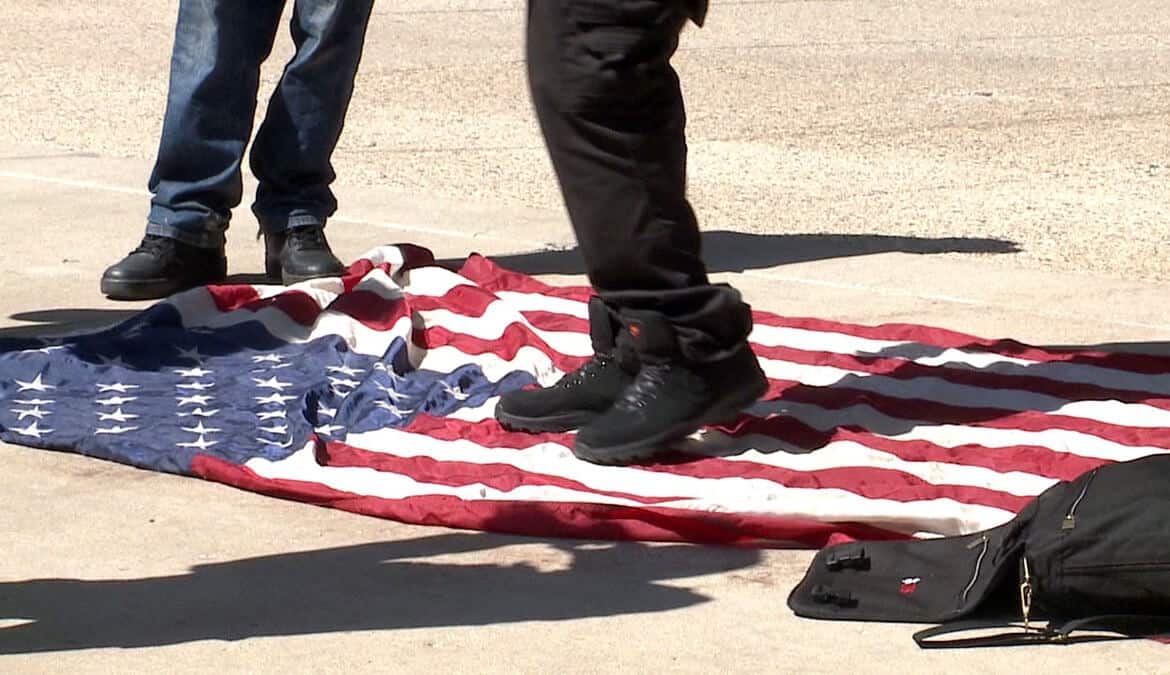

Student “Senators” at the University of California – Davis (UC-Davis) have voted to remove the U.S. flag from future student government meetings.
College news website, Campus Reform, reported on Friday that student “senators” at the University of California – Davis, will no longer require the U.S. flag to be displayed at student senate meetings held at the taxpayer-funded university.
“Something different for every individual”?


In a statement reminiscent of Nancy Pelosi’s infamous comments regarding the U.S. constitution being a ‘living’ document (whose principals may therefore be interpreted as you wish), the student bill’s sponsor, Jose Meneses, stated, “the concept of [the] United States of America and patriotism is different for every individual”.
Meneses, a political science sophomore who self-identifies as Filipino, introduced the student bill and then lobbied other student senators for its passage.
Student opposition
Not all student senators agreed with the change. Fellow student senator Michael Gofman opposed the bill, calling it nothing but a “political statement”. Gofman encourages fellow students who feel strongly about keeping the flag displayed at student senate meetings to let their voices be heard.
Deborah Porter, political director of the UC-Davis College Republicans was also incensed by the change. Said Porter, “Restricting the flag to be displayed at the mercy of the President pro-tempore is a slap in the face to our military members, and their sacrifice, even to the death, for our freedoms. I hold our military members in high respect, and thus vehemently oppose [student] Senate Bill 76.”
The “living” document/symbol fallacy
Meneses’ belief that the flag means something “different for every individual” underscores a troubling mindset prevalent among liberals today, including California Congresswoman Nancy Pelosi (D-CA). Once you assume the symbols of the United States, such as its constitution or its flag, mean something “different for every individual”, then the freedoms represented by those symbols can also be applied “different[ly] for every individual”.
The southern states at the time of the American Civil War believed the “all men are created equal” statement within the Declaration of Independence meant something different for black Americans than it did for white Americans. That assumption, that the Declaration of Independence was a “living” document that could therefore be interpreted differently to suit the political climate of their day, plunged the United States into a devastating civil war.
The U.S. flag – its official purpose and symbolism
The United States flag is an official symbol of the United States of America.
Contrary to Meneses’ belief that it means something “different for every individual”, the U.S. flag’s symbolic meaning and purpose is constant, explicit, and has been codified into law.
Before June 14, 1923, now honored as National Flag Day, there were no federal or state regulations governing the display of the U.S. Flag. On that date, the National Flag Code was adopted by the National Flag Conference.
On June 22, 1942, during the early days of World War II, the U.S. Congress passed a joint resolution, later amended on December 22, 1942, that became Public Law 829; Chapter 806, 77th Congress, 2nd session, governing the precise rules for the use and display of the U.S. flag (36 U.S.C. 173-178).
The “symbol of our country and our freedoms”
While liberal “snowflakes” such as Mr. Meneses and his fellow student senators may not appreciate the symbolism behind the U.S. flag, that symbolism is nevertheless specific and has been explicitly defined by Presidential proclamation.
On July 6, 1971, President Richard Nixon issued Proclamation No. 4064, 36 F.R. 12967,stating the flag “symbolize[s] our enduring Federal Union”.
On 5, 1972, President Nixon also issued Proclamation. No. 4131, 37 F.R. 9311, identifying the flag as “the symbol of our country and our freedoms”.
The student’s actions may subject UC-Davis to liabilities under U.S. Code Title 4 and Title 36
United States Code Section 174 (e) requires, “The flag should be displayed daily on or near the main administration building of every public institution.” Section 174 (g) further states, “The flag should be displayed during school days in or near every schoolhouse.”
In addition, United States Code Title 4 states “No disrespect should be shown to the flag of the United States of America”.
Meneses and his fellow student senator’s removal of the flag from student government meetings will undoubtedly be viewed by many to be an act of disrespect towards the flag, and therefore a potential violation of U.S. Code – Title 4. Its absence at the official meetings of a student government organization within a state-funded college might also be deemed a violation of U.S. Code – Title 36.
A spokesperson for UC-Davis reportedly told Campus Reform, “It is a student effort and student decision, and not an administrative one.”
Individuals wishing to comment on the decision by the UC-Davis’ student senate may contact the university via their website contact form here.
Editor’s note: Mr. Meneses and his fellow student senators might benefit from a refresher course in U.S. history and constitutional law.

